
10 Bad Money Habits Indians Have That Keep Them Poor (And Simple Fixes)
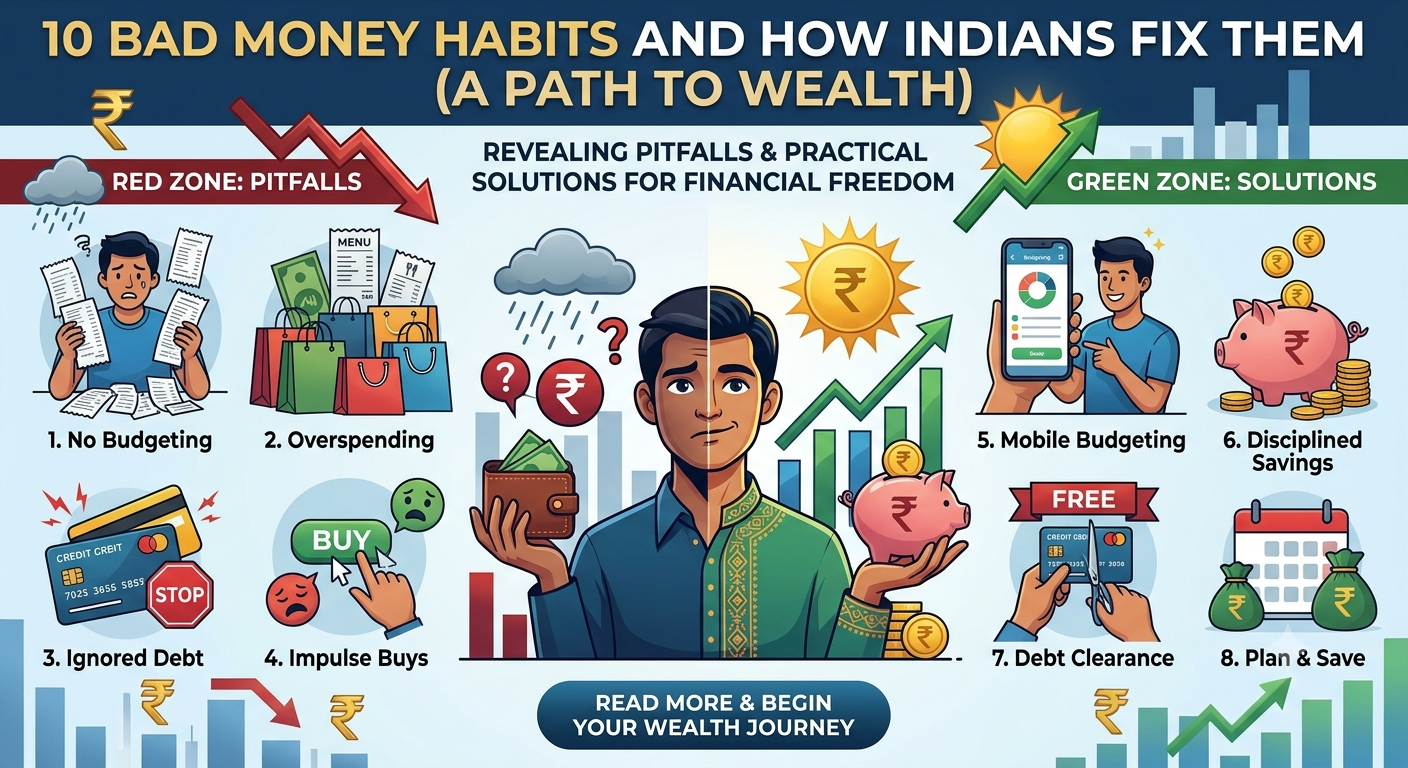
Nobody wakes up and decides to stay poor. Money habits are usually copied from parents, shaped by festivals and weddings, and nudged along by apps that make borrowing a two-tap affair. Most of them feel normal until the numbers show what they cost.
The numbers in 2026 are not comforting. Retail inflation crossed the RBI’s 6 percent upper limit in October, household debt has climbed to record levels, and SEBI’s latest study shows that about nine in ten individual F&O traders lose money. This guide covers ten habits, explains how each one quietly drains your wealth, and gives you a fix that does not need a high income or a finance degree. At the end there is a free calculator that shows what these habits may be costing you each year.
Why Your Money Habits Matter More in 2026
Prices and rates are moving against careless money
India’s retail inflation rose from about 3.9 percent in May to 6.09 percent in October 2026, according to provisional MoSPI data released on November 12, and food inflation jumped to about 8.94 percent. On October 7 the RBI raised its repo rate by 25 basis points to 5.50 percent, its first hike since February 2023, and moved to a “calibrated tightening” stance. In other words, everyday costs are rising and loans are likely to get dearer.
Households are borrowing more than before
- India’s household debt stood at about 45.5 percent of GDP in September 2025, according to the RBI’s Financial Stability Report released in June 2026, and the BIS puts a broader measure at 47.8 percent by December 2025.
- Non-housing retail loans, such as personal loans, card dues and gold loans, made up about 58.4 percent of household debt.
- Delinquency on small-ticket loans rose to about 6.4 percent in March 2026, from about 4.5 percent two years earlier.
- Net household financial savings were about 6 percent of GDP in 2024-25, still below pre-pandemic levels.
Financial know-how is thin
Only about 27 percent of Indian adults were considered financially literate in the National Centre for Financial Education’s 2019 survey, a figure still widely quoted in 2025 and 2026 reports. That does not mean people are careless. It means most of us were never taught how interest, inflation or insurance really work.
The 10 habits at a glance
| # | Habit | What it costs you | Simple fix |
|---|---|---|---|
| 1 | No emergency fund | Forced borrowing at 24 to 45% | Save 1 month, then 6 months |
| 2 | Paying only card minimums | Interest of about 3.5% a month | Pay the full bill, kill the balance |
| 3 | Saving what is left | Little or nothing is left | Pay yourself first, automatically |
| 4 | Idle money in low-interest accounts | Loses value to inflation | Match each rupee to a goal |
| 5 | Insurance as investment | High premiums, low cover | Term plan plus health cover |
| 6 | Tips and F&O trading | Average loss of about Rs 1.17 lakh a trader | Index fund SIPs instead |
| 7 | Too much gold and property | Concentration, low liquidity | Diversify into financial assets |
| 8 | Lifestyle on EMI | Interest on things that lose value | Save first, then buy |
| 9 | Ignoring retirement, tax, nominees | Late start, missed savings, family hassle | Set up EPF, PPF, NPS, nominees |
| 10 | Silence about money | Mistakes repeat across generations | Monthly money talk |
Habits 1 to 3: Safety and Spending
Habit 1: having no emergency fund
Why it keeps you stuck
Without savings, every surprise (a hospital bill, a job gap, a broken scooter) becomes debt. A 2026 survey by Grant Thornton Bharat of 528 people found that over 80 percent said they could cover living expenses for less than a year if their income stopped. The survey is small and not nationally representative, but it matches what many families report: confidence about income, thin savings about shocks.
The simple fix
- Start with one month of expenses. If you spend Rs 50,000 a month, that is Rs 50,000.
- Automate a monthly transfer on salary day into a separate account.
- Build toward six months (Rs 3 lakh in this example) over 12 to 18 months.
- Keep it boring and reachable: a savings account, a liquid fund or short deposits, not stocks.
Habit 2: paying only the minimum on credit cards
Why it keeps you stuck
Credit cards charge roughly 1.99 to 3.75 percent a month once you carry a balance, which works out to about 24 to 45 percent a year. On a Rs 1 lakh unpaid balance at 3.5 percent a month, the interest alone is Rs 3,500 every month. Paying only the minimum keeps the account alive and the interest running, and it can also hurt your credit score if balances stay high.
The simple fix
- Pay the full statement amount every month so you keep the interest-free period (typically up to about 45 to 50 days).
- If you already carry a balance, stop using the card for new spending and send every spare rupee to the highest-rate card first.
- Compare cheaper options such as a personal loan (typically about 10.5 to 24 percent a year) only if the total cost, including fees, is clearly lower and you stop using the card.
- Check prepayment terms. Under RBI rules effective January 1, 2026, floating-rate loans to individuals for non-business use have no prepayment charges, but fixed-rate loans can still carry them.
Habit 3: spending first and saving what is left
Why it keeps you stuck
When saving comes last, it rarely happens. Every raise gets absorbed by a bigger flat, a newer phone or more subscriptions, a pattern known as lifestyle inflation. The household savings picture reflects this: net financial savings have recovered to around 6 percent of GDP but remain below pre-pandemic levels, while borrowing has kept rising.
The simple fix
- Pay yourself first. On salary day, move 20 percent (or whatever you can manage, even 5 percent) into savings and SIPs before you spend.
- Use the 50-30-20 starting point: about 50 percent needs, 30 percent wants, 20 percent savings and debt repayment.
- Raise your savings rate with each raise. Commit half of every increment to savings before it reaches your spending.
- Remove friction for good habits by using standing instructions, not manual transfers.
Habits 4 and 5: Saving and Protection
Habit 4: leaving money idle where it earns less than inflation
Why it keeps you stuck
Bank deposits are still the single biggest piece of household financial assets, about 34.4 percent in March 2026, and many families keep large sums in plain savings accounts out of comfort. But with retail inflation at 6.09 percent in October 2026, a post office savings account paying 4.0 percent (or a bank savings account paying even less) loses purchasing power every year. Rs 5 lakh sitting at 3 percent while inflation runs at 6.09 percent loses roughly Rs 15,000 of buying power a year.
The simple fix
- Keep only your emergency fund in easy-access accounts. It is meant to be safe, not to beat inflation.
- Match money to goals by time: under 1 year in savings or short deposits; 1 to 5 years in deposits, PPF, NSC or debt funds; 5 years or more partly in equity SIPs.
- Use small savings schemes for guaranteed income. For October to December 2026, PPF pays 7.1 percent tax-free, NSC 7.7 percent, and Sukanya Samriddhi and SCSS 8.2 percent, though each has its own eligibility and lock-in.
- Remember that rates change. The RBI’s rate hike may lift deposit rates over time, so compare before locking in long deposits.
Habit 5: treating insurance as an investment (and being underinsured)
Why it keeps you stuck
Many families buy endowment or money-back policies because they promise “returns” and a tax saving. Those plans mix protection and low-return savings, so the cover is small for the premium paid. Then, when a real emergency hits, the family finds the sum assured is far too low and the health policy is only the employer’s group cover. A 2026 financial-resilience survey also found about 15.6 percent of respondents reporting no spending at all on health, life or car insurance, medical bills or parental care.
The simple fix
- Buy pure term insurance worth roughly 10 to 15 times your annual income if anyone depends on you.
- Buy a personal family health policy on top of any employer cover, with a base cover that suits your city and a low-cost super top-up for big claims.
- Insure parents separately so one claim does not eat the whole family cover.
- Invest separately through SIPs and PPF instead of mixing insurance and investing.
Habits 6 and 7: Investing Mistakes
Habit 6: trading on tips and gambling in F&O
Why it keeps you stuck
Futures and options look like a shortcut: small money, big profit. SEBI’s data says otherwise. In its study of trading behaviour for FY25 and FY26, released in August 2026, about 87.7 percent of individual F&O traders lost money in FY26, and about 91 percent lost across the two years combined. The average net loss per active trader in FY26 was around Rs 1,16,654, the highest in five years, and options accounted for roughly 91.6 percent of the total losses.
The simple fix
- Stay out of derivatives unless you have a tested strategy, money you can afford to lose and a strict loss limit.
- Do not act on tips from messaging groups, influencers or “gurus”. Check that anyone giving advice is a SEBI-registered adviser.
- Invest through low-cost index or diversified funds with a SIP, and hold for five years or more.
- Cap speculation at a small share of your money, such as 5 percent, if you really want to experiment.
If you decide to start a SIP, most popular platforms offer direct mutual funds without commission, based on their published pricing around mid-2026. Compare the current terms before you sign up:
| Platform | Mutual fund route | Good for |
|---|---|---|
| Groww | Direct mutual funds in the Groww app | Beginners who want a simple app |
| Zerodha | Coin, for direct mutual funds | Long-term investors who like reports |
| Upstox | Direct mutual funds in the Upstox app | People who want investing and trading tools in one place |
The badges are brand-coloured name tags, not official logos.
Habit 7: keeping too much in gold and property
Why it keeps you stuck
Indians love physical assets, and for good reason: gold and land have been trusted stores of value for generations. According to revised national accounts data, roughly two-thirds of household savings (about 67 percent in 2024-25) were in physical assets and only about a third in financial assets. Gold has rallied hard recently, with the August 2026 CPI showing gold, diamond and platinum jewellery prices up about 35.5 percent year on year. The problem is concentration: gold pays no income, property is hard to sell quickly, and a portfolio built only on them can miss other growth and leaves you cash-poor in a crisis.
The simple fix
- Treat gold as a slice, often 5 to 10 percent of your investments (a common rule of thumb, not a rule), and consider gold ETFs or sovereign-style options for part of it.
- Do not stretch to buy property that will use more than about 30 to 40 percent of your take-home pay in EMIs.
- Build financial assets in parallel: EPF, PPF, equity funds, debt funds and a liquid emergency fund.
- Do not pledge gold casually. It is easy to get a gold loan, but if you cannot repay, you lose the asset.
Habits 8 to 10: Planning and Mindset
Habit 8: turning lifestyle into EMIs
Why it keeps you stuck
“No-cost EMI” offers, buy-now-pay-later and instant loan apps make it easy to turn every wish into a monthly payment. Fintech lenders disbursed about 13.2 crore loans worth around Rs 2.15 lakh crore in FY26, and nearly 90 percent of them were below Rs 1 lakh. Small loans feel harmless, but together they eat your monthly income. Gold loans have also surged: bank gold loans reached about Rs 4.61 lakh crore in March 2026, against roughly Rs 24,671 crore in March 2019, a sign that more families are borrowing against jewellery to fund day-to-day needs and events.
The simple fix
- Follow the “save first” rule: for any non-essential purchase, save up for it, or at least pay 50 percent upfront.
- Keep total EMIs below roughly 30 to 40 percent of take-home pay, including every loan, card EMI and app instalment.
- Add the full cost, not the monthly amount, before you say yes. A “no-cost” EMI can still carry processing fees and a higher product price.
- Use the 48-hour rule for anything above a set amount. Wait two days before buying.
- Budget for weddings and festivals with a sinking fund that you save into all year, instead of borrowing at the last minute.
Habit 9: ignoring retirement, taxes and nominations
Why it keeps you stuck
Retirement feels far away, so it gets postponed. The same 2026 Grant Thornton Bharat survey reported that about 82.7 percent of respondents felt unprepared for life after work, even though around 76 percent said they had no loans. Taxes and paperwork get the same treatment: people pick a tax regime by habit, file late, or never add nominees, which can cost refunds, interest or years of family hassle.
The simple fix
- Use your EPF and do not withdraw it when you change jobs.
- Open a PPF account. It pays 7.1 percent for October to December 2026, tax-free, up to Rs 1.5 lakh a year with a 15-year lock-in.
- Consider NPS for a low-cost, market-linked pension, and run equity SIPs for long-term growth.
- Aim for a rough retirement target of 25 to 30 times your yearly expenses.
- Compare tax regimes each year. For FY 2026-27, income up to about Rs 12.75 lakh of salary is effectively tax-free under the new regime, but the old regime can win if you have large deductions.
- File your return on time (usually by July 31 for salaried individuals, though it can be extended) and check your Annual Information Statement first.
- Add nominees to every bank account, deposit, mutual fund, demat account, insurance policy and retirement account, and write a simple will.
Habit 10: never talking about money
Why it keeps you stuck
In many homes, money is a taboo subject: parents do not share their finances, spouses hide purchases, and children learn only by copying. When nobody talks, nobody learns, which may be one reason only about 27 percent of adults in India meet the basic definition of financial literacy. Silence also makes families vulnerable to scams, “sure-shot” schemes and well-meaning but bad advice from relatives and social media.
The simple fix
- Hold a monthly “money date” of 20 minutes with your spouse or family to review spending, savings and debts.
- Share the basics with parents and children: where accounts are, which policies exist, and who the nominees are.
- Learn one concept a month such as compounding, inflation or term insurance from regulator-run or reputable resources.
- Verify before you trust. Check that an adviser is SEBI-registered and that an investment is regulated before putting money in. Never share OTPs or app permissions.
- Set limits on lending to relatives: lend only what you can afford to lose and keep a record.
Your 30-Day Fix Plan (Plus Calculator)
One week at a time
| Week | Focus | What to do |
|---|---|---|
| Week 1 | See the truth | List every loan and card with balance and rate. Note your monthly spending for the last 3 months. Cancel unused subscriptions. |
| Week 2 | Automate | Set a standing instruction for savings on salary day and a separate emergency account. Pay card bills in full. |
| Week 3 | Protect | Check health cover and term insurance. Get quotes for any gap. Add or update nominees. |
| Week 4 | Grow | Start a SIP of Rs 500 or more, open a PPF account if you do not have one, and book your first monthly money date. |
Try it: what are your habits costing you each year?
Risks and Mistakes When Fixing Your Habits
- Trying to fix everything at once. Pick two habits this month, such as the emergency fund and card dues, and add more later.
- Going to extremes. Cutting all enjoyment leads to burnout and rebound spending. Keep a small fun budget.
- Cancelling insurance to save money. Dropping health or term cover to free cash can cost far more than the premium if something goes wrong.
- Moving everything into equity too fast. Equity funds can fall 20 to 30 percent in a bad year. Build the emergency fund and clear card debt first, and invest money you will not need for 5 years or more.
- Borrowing to pay off borrowing. A new loan helps only if the total cost, including fees, is lower and you stop using the old credit.
- Falling for “get rich” fixes. Anyone promising guaranteed returns, “debt settlement” for a fee or secret strategies is a warning sign.
- Ignoring rising rates. After the RBI’s October hike, floating-rate loans and new borrowing may become costlier. Review your loans and deposits regularly.
- Relying on a single number. Averages and rules of thumb are starting points. Adjust them for your city, family and income.
- Changing rules. Tax rules, scheme rates and insurance terms change. Recheck the facts before you act.
Frequently Asked Questions
What are the most common money mistakes Indians make?
The most common are having no emergency fund, carrying credit card balances, saving only what is left after spending, keeping too much money in low-interest accounts, buying insurance as an investment, trading on tips, concentrating in gold and property, and ignoring retirement and nominations.
How much should I keep in an emergency fund?
Aim for at least six months of essential expenses, built in stages: one month first, then three, then six. If your income is irregular, aim for nine to twelve months. Keep it in a savings account, liquid fund or short deposits.
Is it bad to pay only the minimum due on a credit card?
Yes, if you keep doing it. Interest is charged on the remaining balance at roughly 24 to 45 percent a year, so a small minimum payment can keep a debt alive for years. Pay the full statement amount whenever you can.
Is F&O trading a good way to make money?
For most individuals, no. SEBI’s data shows about 87.7 percent of individual F&O traders lost money in FY26 and about 91 percent lost across FY25 and FY26 combined. A long-term SIP in diversified funds is a far more reliable route for ordinary investors.
Is it wrong to invest in gold and property?
No, but both are better as parts of a plan than the whole plan. Gold and property are harder to sell quickly and do not produce regular income, so balance them with financial assets such as EPF, PPF, equity funds and an emergency fund.
How much term insurance and health insurance do I need?
A common rule of thumb is term cover of 10 to 15 times your annual income if others depend on you. For health, many planners suggest a base cover of at least Rs 10 lakh in metro cities and Rs 5 lakh or more elsewhere, topped up with a super top-up. Treat these as starting points and adjust for your family.
How can I start saving if I earn very little?
Start with 5 percent of your income, or even Rs 500 a month, through an automatic transfer on salary day. Raise it by 1 percentage point every few months and whenever you get a raise. The habit matters more than the amount.
How long does it take to fix bad money habits?
Basic fixes such as automating savings and paying card bills in full can be set up in 30 days. Clearing debt and building a six-month emergency fund usually takes 12 to 24 months. Check your progress every quarter and keep going.
The Bottom Line
Money habits are learned, which means they can be unlearned. In 2026, with inflation above 6 percent, the repo rate rising and household debt at record levels, small habits like paying card minimums, keeping savings idle or trading on tips cost more than ever. The fixes are not complicated: build a cushion, pay card bills in full, save automatically, protect your family, diversify, borrow carefully, plan for the long term, and talk about money.
Pick one habit from this list, set up its fix this week, and book a date for your first family money talk. Small, automatic changes add up far more than any dramatic resolution.
Disclaimer: This article is for educational purposes only and is not investment, tax, insurance or legal advice. Figures such as inflation (6.09 percent in October 2026, provisional), the RBI repo rate (5.50 percent after the October 7, 2026 hike), small savings rates (October to December 2026), household debt (RBI Financial Stability Report, June 2026), gold loans and SEBI’s F&O trading study (August 2026) are approximate, were current as of November 2026, and may change. Survey figures from the Grant Thornton Bharat Financial Resilience Report 2026 come from a small sample of 528 respondents and are indicative only. Rules of thumb for emergency funds, insurance cover, gold allocation and EMI limits are general guidelines, not recommendations for your situation. Zerodha, Upstox and Groww are trademarks of their respective owners; the colour badges are illustrative name tags, not official logos, and this post is not affiliated with or endorsed by them. Mutual fund investments are subject to market risks. Consult a SEBI-registered investment adviser, a Chartered Accountant or a licensed insurance adviser before making decisions.